
A decade ago, operators competed by offering the biggest game library.
Today, that’s no longer enough.
Most successful casinos already provide thousands of slots from dozens of studios. Adding another provider rarely changes the business. What creates a competitive advantage is how efficiently new games are integrated, managed, and scaled.
In 2026–2027, casino growth is increasingly driven by infrastructure rather than content alone.
More games don’t automatically mean more revenue
Many new operators assume that launching with 10,000 games guarantees success.
In reality, player engagement usually concentrates around a relatively small percentage of the catalogue. The real challenge isn’t acquiring more content - it’s delivering that content through a reliable platform.
Every new provider introduces new APIs, payment flows, reporting requirements, bonus mechanics, and compliance considerations.
Without a structured integration strategy, complexity grows much faster than revenue.
APIs have become the foundation of modern casinos
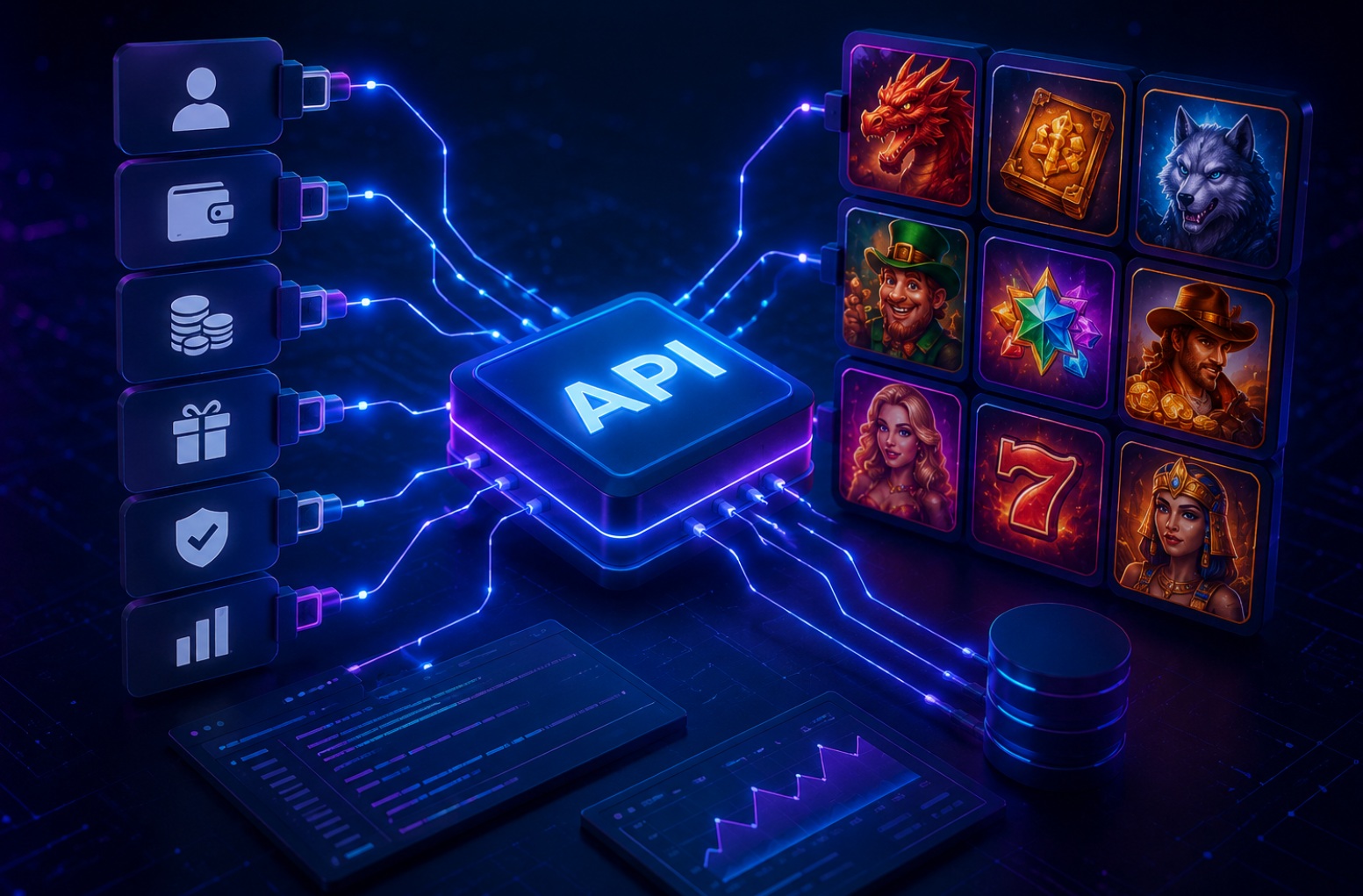
Every time a player launches a slot, several systems communicate almost instantly.
The platform verifies the player session.
The wallet confirms the available balance.
The game provider generates the outcome.
The transaction is recorded.
Analytics update in real time.
From the player’s perspective, this entire process takes only a second or two.
Behind the scenes, dozens of API requests are working together.
A poorly designed integration layer can lead to failed game launches, incorrect balances, duplicate transactions, or delayed reporting.
One wallet. One source of truth.
Players don’t think about technical architecture.
They simply expect their balance to be accurate.
Whether they’re playing slots, live casino or sports betting, they want one wallet that works everywhere.
For operators, this is far more than a convenience feature.
A unified wallet simplifies:
payment reconciliation; bonus management; fraud monitoring; customer support; financial reporting.
Without it, even small transaction errors can quickly become operational problems.
Reliability matters more than speed
Launching a new game provider quickly is valuable.
Launching one without proper testing is expensive.
Before a new integration goes live, experienced operators usually validate:
payment processing; interrupted sessions; rollback scenarios; bonus compatibility; reporting accuracy; peak traffic performance.
Many platform issues don’t appear during normal testing.
They appear during a major tournament, a promotional campaign, or when thousands of players connect simultaneously.
Infrastructure should be designed for peak demand - not average traffic.
Think beyond today’s launch
Technology evolves continuously.
New payment methods emerge.
Regulations change.
Game providers expand their APIs.
Player expectations increase.
A platform built only for today’s requirements often becomes tomorrow’s limitation.
This is why modular architecture has become the preferred approach across the industry.
Instead of rebuilding an entire platform every time the business grows, operators can integrate new providers, payment systems, CRM tools or regional services without disrupting existing operations.
Choosing the right technology partner
When evaluating a platform provider, game count should never be the first question.
More important questions include:
How quickly can new providers be integrated? Is the platform designed for multiple jurisdictions? Does it support scalable payment infrastructure? Can new services be added without rebuilding the backend? How are monitoring, reporting and fraud prevention handled?
These factors determine how efficiently a casino can grow over the next five years - not just how it launches.
The bigger picture
The most successful casino platforms aren’t necessarily the ones with the largest game catalogues.
They’re the ones built on reliable infrastructure.
Games attract players.
Architecture keeps the business running.
As competition continues to increase in 2026 and beyond, operators that invest in scalable technology, clean integrations and operational resilience will be far better positioned to expand into new markets and respond to changing industry demands.
You must log in or # to comment.